Sunglasses SVG: Graphics for Crafts & Creative Projects
As a graphic designer who’s built brand identities for boutique skincare lines, seasonal pop-up shops, and Etsy-based handmade businesses, I recently evaluated Sunglasses SVG for a real client project: a summer-themed capsule collection for a small-batch sunglasses brand launching at a coastal makers’ market. My goal wasn’t just to see if it looked nice—it was to assess whether this asset could function as a reliable, versatile, and commercially safe graphic design asset across packaging, social media graphics, printable designs, and in-store signage.
A First Impression That Sets the Tone
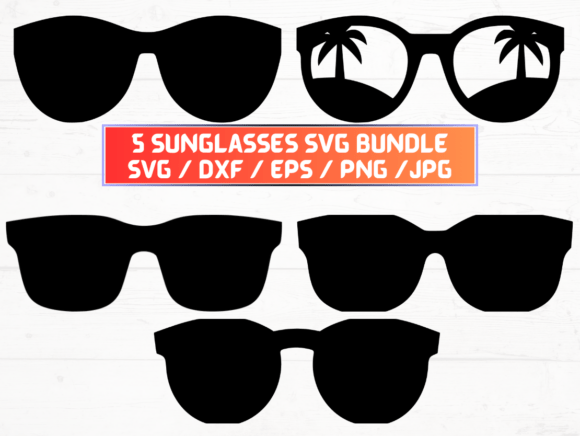
Opening the ZIP folder, I was immediately struck by how cohesive and intentionally styled the five variations are—each with clean line work, balanced negative space, and subtle stylistic nods to retro-modern illustration. These aren’t generic clipart sunglasses; they carry a distinct visual mood: breezy but intentional, playful but polished. Think sun-drenched editorial design meets accessible craft sensibility. They read as modern design without leaning into sterile minimalism—perfect for brands that want warmth, approachability, and seasonal energy without sacrificing professionalism.
Where Sunglasses SVG Shines in Real Client Work
This SVG design excels where many decorative assets falter: in layered, multi-format execution. The inclusion of 5 SVG Files, 5 PNG Files at 300 dpi with transparent background, 5 DXF Files, 5 JPG Files, and 5 EPS Files means it adapts seamlessly to diverse production needs—from Cricut projects and sublimation design to print-on-demand mug mockups and Canva templates for Instagram Stories.
- Product mockups: Placed on matte-finish tote bag or enamel pin mockups, the SVG version scales flawlessly—no pixelation, no awkward anti-aliasing.
- Packaging design: Used as a subtle watermark on recycled kraft boxes or as a foil-stamped accent on hang tags, the vector clarity holds up even at 1.5 cm height.
- Social media graphics: Paired with bold sans serif fonts (like Montserrat or Poppins), it anchors summer campaign posts—especially Pinterest pins and carousel ads where visual recognition matters more than fine detail.
- Printable design: The high-res PNGs printed crisply on sticker sheets and wall art posters—no haloing around edges, thanks to clean transparency.
- Brand identity support: While not logo-ready on its own, it works beautifully as a secondary brand element—think email headers, loyalty card icons, or seasonal newsletter dividers.
Smart Use Cases for Designers & Small Business Owners
Sunglasses SVG is strongest when used as a thematic anchor—not a standalone hero. It fits naturally in handmade business branding, especially for beachwear labels, artisanal eyewear startups, or local festival vendors building a cohesive visual language. I used one variation as a repeating pattern on a limited-edition greeting card series and another as a focal point in a digital ad banner for a “Sunshine Sale” promotion. In both cases, it elevated the emotional appeal without competing with core messaging.
It also performs well in creative marketplace contexts—Etsy sellers can drop it directly into Canva templates for shop banners or use the DXF files for vinyl cutting on custom apparel. For print-on-demand sellers, the EPS and SVG formats ensure compatibility with platforms like Printful and Gooten while preserving scalability.
Where to Proceed With Intention
This isn’t a universal solution. Sunglasses SVG should be used carefully in contexts demanding extreme visual hierarchy or formal tone. Avoid placing it in minimalist corporate reports, medical wellness branding, or luxury watch packaging—its expressive charm can dilute seriousness. It also loses legibility below 8 mm in print or when overlaid on busy, low-contrast backgrounds (e.g., light grey text on a textured beige photo). In those cases, test contrast rigorously—and always preview in black and white to confirm silhouette strength.
Designer Notes You’ll Actually Use
Before deploying Sunglasses SVG in a commercial design, I recommend these practical checks:
- Test file editability: Open the SVG in Illustrator or Affinity Designer—confirm anchor points are smooth and paths aren’t nested unnecessarily.
- Verify transparency: Drop the PNGs onto dark and light backgrounds in Figma or Photoshop—check for fringing or faint halos.
- Assess scale fidelity: Resize one SVG from 200 px to 2000 px—look for distortion in curved lens details or inconsistent stroke weights.
- Font pairing test: Try it beside serif (e.g., Playfair Display), script (e.g., Pacifico), and display fonts (e.g., Bebas Neue)—note which combinations reinforce vs. clash with its rhythm.
- Licensing check: Confirm the commercial license explicitly permits use in client deliverables, resale items (like stickers or mugs), and digital products (e.g., Canva templates).
- Mockup realism: Place it on a real product mockup—not just a flat canvas—to evaluate proportion, weight, and integration with materials like linen, ceramic, or matte plastic.
Final Verdict: A Thoughtful Addition to Your Design Assets
Sunglasses SVG isn’t flashy—but it’s dependable. As a creative design tool, it bridges the gap between expressive illustration and functional versatility. It supports small business branding without requiring heavy customization, adds thematic cohesion to marketing visuals, and integrates cleanly into both analog crafts and digital workflows. For designers building seasonal campaigns, launching Etsy products, or supporting local makers, it’s a quietly powerful digital product—one that earns its place in your working library of design assets.