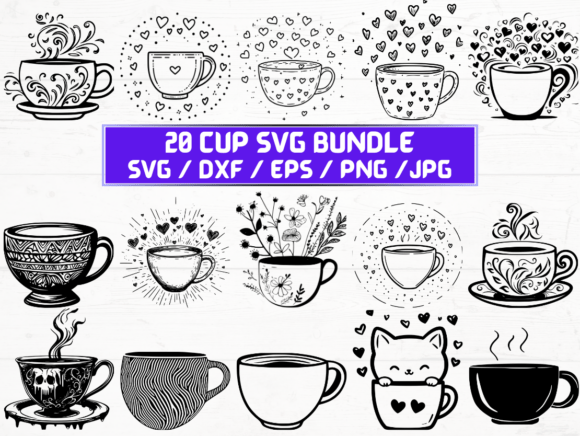
Cup SVG File: Graphics for Crafts & Local Branding
As a brand designer who’s helped over 70 local businesses refine their visual identity—from artisanal coffee roasters in Portland to hand-poured candle studios in Asheville—I opened the Cup SVG File with quiet curiosity. Not as a shopper scanning a creative marketplace, but as a practitioner evaluating whether this graphic design asset could meaningfully elevate real-world packaging, labels, and promotional materials. What I found wasn’t just clipart—it was a quietly versatile illustration set that bridges handmade warmth and professional polish.
A First Impression That Feels Like Home
The collection leans into soft curves, gentle line weight, and subtle organic texture—think ceramic mugs with steam curls, minimalist tumbler silhouettes, and illustrated teacups with delicate floral accents. It doesn’t shout “modern tech startup” or “luxury spa.” Instead, it whispers local, thoughtful, and human-made. For a small-batch skincare brand launching lavender-honey body oil, these cups instantly reinforce botanical sincerity. For a neighborhood bakery rolling out seasonal maple-pecan lattes, they add warmth without clutter. The mood is friendly, grounded, and quietly confident—not overly decorative, not sterile. It’s the kind of visual language that builds trust before a single word is read.
Where This Graphic Design Asset Earns Its Keep
In practice, the Cup SVG File shines brightest where authenticity meets utility:
- Product labels — Layered behind hand-lettered flavor names on glass apothecary jars or printed directly onto kraft paper coffee bags.
- Packaging accents — Used as repeating border elements on gift boxes for handmade soap or as corner flourishes on candle sleeve designs.
- Hero graphics — Scaled boldly for café menu boards, farmers’ market banners, or Instagram Story highlights announcing new seasonal blends.
- Printable design elements — Embedded in thank-you cards tucked inside online orders, or resized for sticker sheets sold at local boutiques.
- Social media graphics — Paired with clean sans-serif type for weekly “Behind the Brew” reels or styled alongside script fonts for holiday promo posts.
Because it includes 20 SVG files (vector-editable, infinitely scalable), 20 PNGs at 300 dpi with transparent backgrounds, plus EPS, DXF, and JPG variants, you’re never locked into one use case. Need crisp edges for laser-cut hang tags? SVG delivers. Want to drop it cleanly over a textured background photo for a website banner? The PNG transparency holds up. Planning CNC-cut wooden coasters? The DXF files are ready.
How It Strengthens Real Small Business Branding
This isn’t about slapping a cup on everything. It’s about consistency with intention. When a local florist uses the same cup motif across their reusable tote bags, product mockups, and Instagram carousel posts, customers begin recognizing that visual shorthand—like a quiet signature. That recognition builds faster than any slogan. In shelf-stacked retail environments, that subtle cup detail on a tea box creates visual hierarchy against competitors’ flat typography. On a handwritten price list at a pop-up shop, it adds polish without pretension. And because every file is production-ready, it supports stronger first impressions, clearer brand storytelling, and more cohesive marketing visuals—all essential for local business growth.
Use With Care: Context Is Everything
Like any strong design element, the Cup SVG File has boundaries. It’s not ideal for formal corporate branding (think law firms or financial advisors), nor does it carry the stark minimalism needed for luxury minimalist brands. Avoid placing it on very small labels—under 0.75” height—where fine details like steam lines or handle contours blur. Steer clear when ingredient lists or regulatory text dominate the layout; here, decoration competes instead of complements. Also test carefully against low-contrast backgrounds (e.g., light gray on off-white)—the PNG transparency works beautifully, but legibility suffers if the cup blends too softly into its surroundings.
Practical Brand Designer Notes You’ll Actually Use
Before committing to full-scale use across packaging or digital campaigns, run these checks:
- Test it on a real product mockup—print a label sample and hold it beside your actual jar or bag.
- Check black-and-white output: Does the cup retain shape and clarity when converted to grayscale for cost-effective printing?
- Preview it at actual label size—especially if applying to curved surfaces like mason jars or tapered tumblers.
- Layer it over your brand color palette: Does it harmonize with your primary and secondary hues—or clash subtly with undertones?
- Compare side-by-side with top 3 local competitors’ packaging: Does it differentiate, or unintentionally echo?
- Inspect SVG paths: Are strokes clean and editable? Can you easily recolor or simplify handles or steam for different applications?
- Test typography pairings: Try it beside serif (e.g., Playfair Display), sans serif (e.g., Montserrat), script (e.g., Pacifico), and display fonts (e.g., Bebas Neue) to gauge visual harmony.
- Verify commercial licensing: Confirm the license explicitly permits use in physical product sales, client work, and branded merchandise—not just personal projects.
For small business owners, handmade sellers, and local brand builders, the Cup SVG File isn’t just another digital product—it’s a quietly powerful tool for building recognition, reinforcing values, and elevating everyday touchpoints. Whether you're designing your first candle label or refreshing your café’s entire visual system, this graphic design asset supports professional branding without demanding expert-level software skills. It meets craft with clarity—and that’s exactly what local business branding needs.